My Weight Loss Journey
...and information about the American diet and making
healthy eating choices whether you need to lose weight or not!
In January 2007 I was inspired to do something about my health and weight. I made a major change to my eating regimen that took me away from the standard American diet I had been doing for over 40 years. I moved to a different way of eating designed to be more in concert with the types of foods the body needs for proper weight maintenance and overall good health.
It worked.
My story is below.
About this document...I tend to edit this document once in a while, so consider it "not done". :-) I don't hook this document up to my site and tend to share it with people who are curious. If you know of someone who would be interested, please forward it along. My e-mail address is at the very bottom of this page if you would like to contact me.
DISCLAIMER: Before anyone goes saying that I'm advertising something, I'm not. Really. Much of this information is available for free at UltraMetabolism.com or at other sources. I have no connection to UltraMetabolism or Dr. Mark Hyman other than being very grateful to Dr. Hyman for helping to inspire me and educate me. And I hope he and I can inspire you as well.
| The stats so far... | ||||||||
| At the max: 245 lbs At the start: 238 (mid-January 2007)
|
||||||||
| 17 weeks later: 204 Loss after 17 weeks: 34 (~2 lbs/week) Total amount lost: 41 |
||||||||
| 22 weeks later: 200 Loss after 22 weeks: 38 (~1 lb/week over the last few weeks) Total amount lost: 45 Midway through the 23rd week my weight broke 200, the first time I'd been below that barrier in years. |
||||||||
| July 8, 2007: 192 Loss: 46 Total amount lost: 53 I lost count of the weeks, but it's just under 6 months. I was on vacation, but my friends were wonderfully accommodating (thank you!!!), so I was able to continue with my usual regimen...well, if you overlook the extra few beers I had. :-) I managed a staggering four pounds during the week...just how I'll never know! |
||||||||
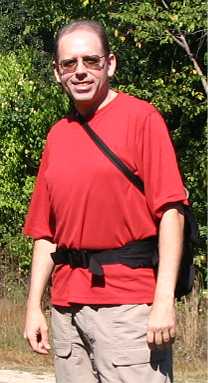
| September 8, 2007: 187 Loss: 51 Total amount lost: 58 I was wondering when I'd get to 50 pounds! I believe that my calorie intake is now matching my metabolism, as my weight is staying stable. I went up a little, changed what I was eating (more seeds/fiber, fewer raisins), and immediately started back down.
The belt around my tummy is one of those fanny pack backpack things to carry water, snacks, a first aid kit, and so on. A few months ago I could barely get the thing on--the straps weren't really long enough. Now I've got to cinch the straps a few inches. |
||||||||
| September 29, 2007: 185 Loss: 53 Total amount lost: 60 Weight loss is slow but still in the right direction, which is not a bad thing. I tend to bounce between 186-187, but this is the first time I've seen 185 in...well...years...and I expect it to bounce up a little and back down, no biggie. This week at volleyball when I jumped up to block a hit, my teammate Dan said, "Wow! You got some 'hang time' there!" I just started chuckling---I am not athletic and am not really associated with anything like "hang time", but it's nice that I got some of that, huh? :-) |
||||||||
| January 12, 2008: 180 - roughly one year
after starting the new regimen. Loss: 58 Total amount lost: 65 Heh, I thought this was amusing. I returned from a nine day trip over the Christmas Holiday to see my friends in Pennsylvania. Before I left, I was somewhere around 183, but I returned to see 176 on the scale...and I reset the scale and did it a few times just to be sure. My friends are very accommodating and put up with me and my regime, even going out of their way to grill up some chicken and prepare some veggies for me--even banging their heads to put together a stir fry that I'd eat on my last night there. I have great friends! As I knew it would, getting back to my regular regime has me at about 180. If I'm going to lose any more weight, I'm going to let my body do it--I'm not going to force it.
|
||||||||
| March 21, 2008: 179 Loss: 59 Total amount lost: 66 In consultation with my doctor, I am no longer taking blood pressure medication. My BP was up around 140-145 over 95 (or even more), and now it is roughly 125/87 without medication. I will keep an eye on it, though---if it creeps up again, I'll need to do something, but it is my belief that the change in regimen outlined here was directly related to my improved blood pressure numbers. As a side note, I'm also investigating adopting a more vegetarian lifestyle. In my initial experiments I have discovered that I am much more mellow and "even" for energy, but the difficulty in getting enough protein is rather obvious, so I make an extra effort to eat soy-based food, beans, and other protein-rich foods. B12 is another concern, and for this I take a supplement. I find I'm not sleeping quite as well lately, and I do feel a bit hungry at times. But I am not giving up and will continue to experiment and change things so they work better for me. Please be aware that the regimen outlined below is not a vegetarian regimen, and even now I still consume fish oil and may even eat lean animal protein once in a while, although I am making an effort to do without animal-based food. You do not have to do this to enjoy the benefits of the information below. In fact, Dr. Hyman's UltraMetabolism plan includes animal protein. Taking the next step beyond that is my own choice, and I thought it would be interesting to try. I'm not sure how I like it yet...time will tell. |
||||||||
| April 26, 2008: 172 Loss: 66 Total amount lost: 73 Between a weekend away, a stressful early part to the week, and continuing a more vegetarian lifestyle (again: you do not need to do this!), I have lost some additional weight, and yet I haven't been any hungrier than usual--I've been eating all my normal stuff. I did a 6-mile hike (click here, see "Ted's Trail - North Pack - April 26, 2008"), and my usually annoyed knee did not feel any pain at all the entire way (nor the day after). Although we weren't exactly going at racing speed, I was never out of breath, nor was I ever tired during the day, and I barely noticed the uphill stretches. I continue to feel pretty darn good! |
||||||||
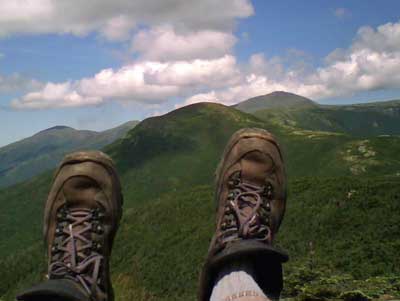
| July 8, 2008: 170 Loss: 68 Total amount lost: 75
That's a view of Mt. Eisenhower (center) and Mt. Washington (in back to the right) from Mt. Pierce in the White Mountains of New Hampshire, which I hiked on July 4. It's my first "4000-footer" in years. I did some additional (but lower) hikes on the 5th (Mt. Potash) and 6th (Indian Head / Mt. Pemigewasset)--I don't know how long it's been since I hiked three days in a row to any altitude at all. None of these hikes is especially strenuous, but I really didn't have any trouble with them, which is encouraging. |
||||||||
| August 9, 2008: 170 Loss: 68 Total amount lost: 75
I just returned home from vacation with some wonderful friends at a lakeside house near Milford, Pennsylvania. I got to take some pretty good news with me on vacation: I had a physical exam the day I left, and I was told not to come back for a year--previously my doctor wanted to see me every six months. I'm not sure you can get better news from your doctor. :-) |
||||||||
| ?? weeks later: ??? --> Where will I finally end up? To be honest, I haven't set a goal and believe that my body will tell me where it wants to be. | ||||||||



These are MY experiences---your mileage WILL vary. I'm not a medical doctor (and you should consult your doctor before changing anything you do for your health). I'm simply sharing what I have learned and observed.
|
Does your body know what
to do with
|
The story of my recent weight loss...
Obesity is chronic in America. I fell victim to it. Genetically I'm in trouble with one amazingly obese aunt, another who's up there, and a father who's no light petunia. My mom's a stick figure, though, but I really don't take after her.
My weight had been up a bit in late 2001 (probably around 210 or so), but then I took a job at a startup company in early 2002, and that was that. With a focus on work for the next four years, my weight eventually went up another 35 pounds or so and topped out at 245. Ouch.
Your Webmaster - April and July 2000
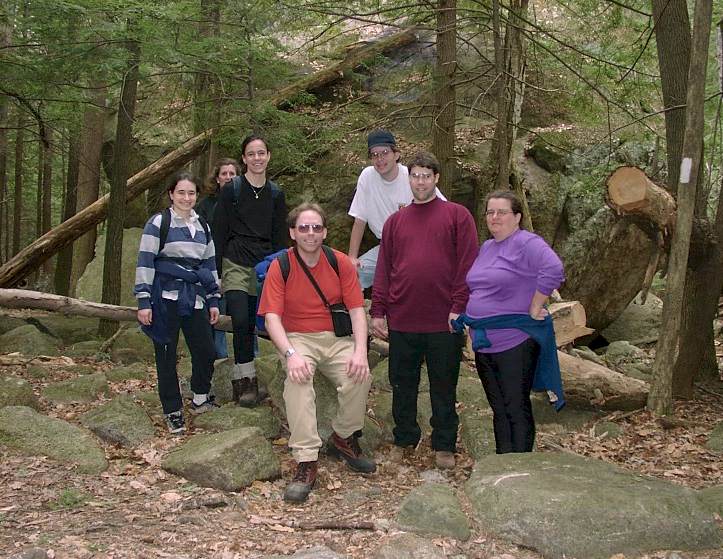
Some GONewEnglanders and I head out to Pawtuckaway.
I'm the guy in the orange shirt sitting down on the rock.
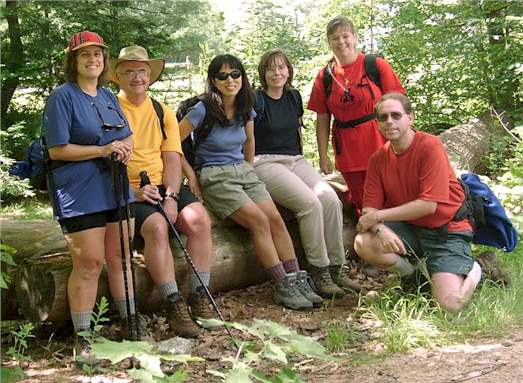
GONewEngland at Kidder Mt.
That's me on the right in the glasses wearing the orange shirt.
I figure I was around 195 or 200 there, possibly less, but I was very active (yet still ate the same as I did until recently). You can definitely see the difference between those shots and the below.
Your Webmaster - 2005

Your Webmaster in 2005 at Skatutakee.
Now in July 2005, above. Yeah, well...And it got even worse from there. It may not look too bad, but your buddy here was medically "obese", probably around 235 lbs. in that picture. Eventually it went to 245, accompanied by the need to start taking blood pressure pills and encountering a variety of annoying ailments.
The ideal weight for someone around my height is somewhere between 175 and 195 pounds (depending on whom you speak to), so I was over that...by a lot.
Inspiration
In January 2007 I was hit by a double-whammy that pushed me to do something about my health.
 |
On PBS (the Public Broadcasting Service, a partly educational and partly propaganda US Government radio and television network that Americans are forced to pay for) they aired a show about "UltraMetabolism", a way of eating and health developed by Dr. Mark Hyman of Massachusetts, USA. |
|
The MSNBC cable television network also aired "Supersize Me", an independent film that tracked a healthy male on a diet of nothing but McDonald's food for a month. |
The presentation by Dr. Hyman on the PBS show made it very clear what's wrong with the American diet, how it is harmful, and what to do about it. Meanwhile "Supersize Me" was a brilliant movie about how fast food diets are killing us---literally. I didn't visit McDonald's all that much to begin with, but now I'll never be back.
The PBS show put the thought into my head, as what Dr. Hyman talked about made a lot of sense and seemed to be something I could follow: someone finally decided to explain the "why"---why are sugar and pasta bad for your diet, why should you load up early in the day and coast, why do you continue to put on weight and feel horrible when you do your best to burn more calories than you take in, and so on.
But it was "Supersize Me" where things clicked. I watched a guy in OK shape with a decent life and someone in his life who cared about him decide to trash his body by eating junk. It made me want to yell at the TV set---Dude, don't do that! What are you thinking! You have your health--why do you want to wreck it by eating all the wrong stuff? Then it hit me: I WAS DOING THE EXACT SAME THING TO MYSELF IN A DIFFERENT WAY THROUGH MY OWN DIET, but here I was yelling at him not to do what I myself was doing. DUH. That did it. He didn't need to change. I did.
The messages from these two shows combined and hit me at the right time, and I was moved to do something about my health. There is not a single regret. In fact, I am most thankful for the whack upside the head I got from these two videos---period, end of story.
So why is it so easy to put on weight but so hard to take it off? What are the myths and facts about the American diet and weight loss and health? What can you do if you would like to be healthier?
|
If you're starving
yourself and not taking in what you need in terms of nutrients, |
To lose weight you eat less and exercise more...NOT!
Oh, you've all heard the usual mantra..."You get fat because you take in more calories than you burn off, so eat less and exercise more." So, to lose weight you take in less energy and you burn more off by exercising. Unfortunately that whole theory is WRONG, and it can be more HARM than good! It goes counter to how your body evolved, and it sends all the wrong messages to your body.
Many people starve themselves (eat less) and exercise (burn more). It makes sense if you do the math, but your body isn't based on math. Your body goes into "starvation mode", and you may lose weight for a while, but it becomes tough to take more off and keep it off. This "diet and exercise" program causes you to burn both fat and muscle. And when you go back to eating normally, your body remains in "starvation mode" and puts on only fat. Clearly this is a real loser of a way to lose weight. And in the end it all comes back anyway---as fat.
The bottom line is:
You cannot lose weight by eating less and
trying to burn more calories.
Your body does not work that way.
OK, one more time in case you missed it: You cannot lose weight in a healthy, permanent way by eating less and trying to burn more calories. This isn't how our bodies are designed.
In fact, weight loss is easier than this starvation stuff. You don't have to fight your body. You can work with your body by giving your body what it wants. And when you do that, it's really easy to lose weight and be healthier. In fact, the proper foods can change your body's systems to trigger better health. So if you're starving yourself and not taking in what you need in terms of nutrients, you disrupt the ability of your body to behave in its healthy mode---the way it was designed to operate. Eating less short circuits everything your body was designed to do to work properly. The secret is to get rid of what's holding your body back and eat more of the right things.
|
|
Eat your way to better health and weight loss...and NEVER go hungry?
Yeah, right, you think. Eat more, never be hungry, feel better, weigh less. Sure, sure.
Not believing me? I'll describe to you my experience so far.
|
No pills, no powders, Making the big mental swap into a new way of thinking about nutrition and health is probably the most difficult part for most people.
|
I adopted the food portion of Dr. Hyman's "UltraMetabolism" program. It is largely described in the PBS special, while in his book Dr. Hyman describes additional things to do, such as detoxification, getting rid of "inflammation", and so forth. But I just went for the food stuff for now.
Result? In 17 weeks (mid-January to mid-April 2007) I went from 238 lbs to 204 lbs. That's 2 lbs per week. (And in just about six months my loss approached 50 lbs...and before the year was out it was over 60.)
The kicker? I feel better, sleep much better, have more energy, and am not plagued by hunger.
Let me say this again: By following the recommendations by Dr. Hyman (and others) for food alone, I lost 2 lbs/week for 17 weeks (then about 1 lb/week thereafter), felt better, slept through most nights, have more energy to do things, and didn't have a lot of trouble with hunger.
OK, so you're thinking, there has to be pills, powder, lots of exercise, going to a fat camp, an expensive meal plan, or some gimmick. No, none of that garbage. It's easier than I ever thought it could be.
Here are the principles I have been observing:
- Get rid of "processed foods" including "fast food", processed sugars, nasty fats, and flour-based products (breads, pastas). I even cut out coffee in favor of tea (green tea is said to be very healthy).
- Eat "whole foods". Include a mix of food in your diet---light protein, fiber, good fats (Omega 3s), unprocessed carbohydrates, fruits, veggies, seeds, and nuts.
- If you're hungry, eat. Eat all day. Eat several meals. Eat earlier on during the day if possible (big breakfast, moderate lunch, small dinner, while grazing all day). In fact, you must eat, especially breakfast--no skipping.
- Don't eat 2-3 hours before bedtime. Make sure you give your body what it needs before then, then wait for breakfast (if you have gotten rid of the junk out of your diet, this is not only possible---it's easy).
- Play. Most folks hear "exercise" and roll their eyes. So don't exercise. Play instead. Find something fun for you and do it.
And that's that. Seriously.
And, with that and little else, I'm down 2 pounds per week...and I'm never
really
hungry. You can do this, too, with a little effort and a little
preparation. It is NOT hard. And the benefits are WORTH IT big time!
1) Avoid "processed foods"
"Whole foods" are what you pick off a tree. "Processed foods" are manufactured somehow, stuffed with chemicals, and thrown into a box.
Many processed foods are jammed with calories and fat that at best have no nutritional value and at worst can kill you.
| Trans fats or "hydrogenated" fats are VERY nasty. They're pretty much poison when it comes down to it. Read the labels of things in your cabinet. This stuff is in there. |
| Flour based products, such as bread and pasta, strip out all the valuable fiber and nutrients. Did you know that heavy carbohydrates like this are worse for your cholesterol than mayonnaise? |
| Sugars like cane sugar and corn syrup (also called dextrose and other "ose" things) give you a condition called "prediabetes". What's that? When you eat these types of refined sugars, your body creates insulin to deal with the sugars. Then other things in your body see the insulin and try to clean it up. So your body has to produce more insulin to get rid of the processed sugar you're eating. Then more things try to clean up the additional insulin you made. Do you see the cycle here? Eventually your body considers your own insulin a toxin! |
| Heavy fats from fatty meats, dairy products, and so on, do not have the correct types of fats to promote good health. You want good fats---your Omega 3s, available in fish, Omega 3 eggs, flax seed, and nuts. |
| Things lacking fiber. Candy and many prepared foods don't have any fiber. Fiber is amazing stuff. It slows absorption of sugar, it makes your digestive system work better, and studies have shown that it can help prevent some kinds of cancer. Sometimes it might be better to eat the box the food came in. |
The "down side" of doing away with processed foods is you are not going to find healthy, whole foods at most restaurants in America. Most food at restaurants is starchy, fatty, and sugary with little fiber. Although it's tasty, it's not good for you. The restaurants are coming around---slowly---but for now you'll need to hunt carefully in the menu. Sometimes you can request a particular meal cooked the way you want with a nutritious side dish.
I just tell people I'm "impossible to feed", and they get the idea. :-)
One of the best myths I've heard---and used to believe---is that what you want to have on a hike, for example, is a peanut butter and jelly sandwich, and maybe some cookies. The peanut butter gives you protein and will stick with you, and the jelly and cookies give you instant energy. OK, here's the truth...
| The sugar in the peanut butter, jelly, and cookies burns out quickly and causes a sugar crash, can contribute to "prediabetes" because it is released into your system with little or no fiber to help slow its absorption, and will get converted to fat if not used. It may bring your energy level up for a short time, but you'll crash. It is not sustainable. You will be hungry shortly after eating. |
| Flour-based bread and cookies don't provide fiber, and the heavy carbohydrates can throw off your cholesterol. |
| Check the ingredients in the cookies. In addition to the sugar, there's probably "partially hydrogenated" something or other, and if "fat free" there's probably a ton of calories without much nutritional benefit. And if they're low calorie, there's probably "aspartame" or some other stuff in there. Does your body really know what to do with "aspartame"? |
| Overall there's little nutrition in this meal. You'll be hungry not long after eating it. |
| Those Meal Plans You See Advertised on TV I've seen the various meal plans advertised on TV. You spend $10 a day or something similar, and they send you some meals in a box that are supposed to be nutritious and make you lose weight. I don't know if those meals work. I don't know what's in them. However when they show you the various meals you will get, I notice plenty of pasta and cakes. I suspect that these meals contain partially hydrogenated this and that, refined sugars, starches, various fats, and so forth. I suspect they may be low on things you need, like Omega 3 fatty acids and fiber. I'd like to see an ingredient list for those things one of these days. If you're considering one of those meal plans, ask yourself some questions:
If you have evaluated your meal plan choices and believe one of these plans will work for you, great! I wish you the best of luck and success with the plan! The "meal plan" outlined on this page has you thinking "outside the box". By following a few simple guidelines, I suspect you can meet your health and weight goals by putting forth a tiny bit of effort and putting together your own meals. I suspect you'll save a little money versus the plans. And, more importantly, I suspect that making a lifestyle change as outlined here will be more long lasting and more beneficial than ordering meals in a box for a few months. But please do what YOU and your physician are comfortable with and what is appropriate for YOU. |
2) Eat "whole foods"
Your mother and grandmother were right! The closer food is to what you picked off a tree, dug up from the ground, pulled off a stalk, or have taken from a free-range animal are the best. As Dr. Hyman stresses, that all includes nuts, fruit, seeds, vegetables, eggs, fiber, and light protein. You want to taken in natural sugars, lots of fiber, protein, and good fats (including lots of "Omega-3" fats found in flax seed and fish oil).
Here is what my diet comprises these days:
| Light protein - fish, chicken, eggs. I even grab a shrimp ring once in a while (and just eat the shrimp---the cocktail sauce usually contains sugar). Dr. Hyman recommends organically grown food if possible. |
| Vegetables - anything. I eat a lot of squash, broccoli, peppers, lettuce, tomatoes, and spinach. |
| Fruit - anything. I eat raisins for a snack and usually have an orange or apple nearby. |
| Fiber - whole oats, stone-cut oats (or "pinhead oats"), flax seed, Food For Life Ezekiel products (breads and cereals). Veggies and fruit also contain fiber. I'm a fan of Wasa rye-based crackers. Fiber slows the absorption of sugars, meaning your body's insulin production is more efficient, and it keeps you far away from a "prediabetes" condition. |
| Seeds like sunflower and pumpkin seeds. |
| Good fats - Omega-3 fats in fish, Omega-3 eggs, flax seed, and nuts. |
A typical day for me?
| Breakfast: peppers and eggs or oatmeal with applesauce and flax seed -- breakfast should contain protein and be the "biggest" meal of the day (Americans tend to eat in reverse by skipping breakfast and eating a big dinner). Oh, yes, I have a good multi-vitamin and mineral supplement. |
| Snacking all day: raisins, sunflower or pumpkin seeds, fruit, tea (green tea is very good for you...drink that and lots of water), Wasa crackers, Ezekiel cereal |
| Lunch: salad with a variety of vegetables and some chicken or an egg |
| Late day: an orange |
| Dinner: light protein (chicken, shrimp, fish) with vegetables (I do try to keep this relatively small and often skip dinner entirely because I usually have enough during the day with my other meals and snacking) |
| After dinner: often nothing, but sometimes raisins, an orange, a Wasa cracker, or sometimes an apple with natural peanut butter (no eating 2-3 hours before bedtime, though) |
I have as much as I want of any of this, but I find I'm not really all that hungry. Why? Because I'm eating what my body needs. My body isn't trying to grab every scrap of nutrient it can from garbage food then storing the rest as fat. My body is instead delighted with the nutrients it is getting, and it knows exactly what to do with them. Does your body know what to do with "polysorbate 80" or "partially hydrogenated vegetable oil"? I didn't think so. So try some veggies, seeds, oats, and fruit.
So, let's get back to the hiking food myth. What do you take on that hike instead of PB&J and cookies?
| Eat a high protein breakfast, such as peppers and eggs, and grab some fiber (Food for Life Ezekiel bread, for example)--remember your multi-vitamin, too. Fuel up before you go! |
| Fruit and raisins for snacking |
| Wasa rye-based crackers for snacking (they fill you up with plenty of fiber and do not contain wheat flour) |
| Food for Life Ezekiel bread (no flour) with natural peanut butter or some kind of vegetable sandwich (tomatoes and lettuce with a bit of olive oil maybe) |
The breakfast alone will sustain you for a good while, but you will want to eat all day to keep yourself going. I've tried this on a cross-country ski excursion, and it works like a charm. I wasn't even all that hungry for dinner!
| Sugar Americans eat a lot of refined sugar---granulated sugar, "corn syrup", "dextrose", "cane sugar", "pure cane sweetener", and so on. Check the ingredient list of things you buy. Yes, even if you're a fan of soy milk, you'll find that many brands have some kind of refined sweetener. Refined sugar like this creates a condition called "prediabetes" which causes your body to fight itself over insulin production. Eventually this can lead to the failure of your insulin system, and that brings diabetes and all the wonderful things that come with that. A very dear friend of mine has diabetes. When I tell you it is effing painful for me to know what he goes through, I am not kidding. If the information here or from Dr. Hyman or from other sources can help anyone with diabetes or help someone avoid getting diabetes, that would be too awesome for words, you know?
|
3) Eat.
Heh, that's a tough one. But, yes, eat all day. Try to eat a large breakfast, smaller lunch, and small dinner. Grab for snacks (raisins, seeds, fiber crackers, veggies, some fruit, nuts, and so on) when you're feeling peckish during the day.
I eat all day and drink something (usually tea) all day. I stop a few hours before bedtime and coast 'til the morning, grabbing only water or tea in the evening.
Did I say you should eat, eat, eat? Yes, I think I did. And I'll stick to that. :-) Just eat whole foods and start at breakfast with your "big meal", then coast to the end of the day.
But...wait...if you're eating all day, what about calories?
| Calories Many people have been told to be afraid of calories. Apples and oranges are loaded! Nuts have fat in them, and fat has a lot of calories! So this regimen must be full of calories! EEK! Please stop counting calories. And have an orange while you read the rest of this, OK? There is absolutely no need to count calories. If you are eating a variety of unprocessed, nutritious food (the stuff mentioned on this page), you should not concern yourself with calories at all. Simply listen to your body and give your body what it needs, and you will consume the right amount of calories for you. Your body needs fiber, vitamins, minerals, good fats, and so on. In order to get these things, you need to consume food, which just happens to have little units of energy called "calories". Eh, so what. Your body needs this stuff. Calories help your body create heat and perform other essential tasks. Those "evil" calories are what keep you alive! Meanwhile the vitamins and other good things in food make you healthy. Believe it or not, this is a win-win situation. So if you need to count something, make sure it's the nutrition side of the equation where you need to make sure you're getting a variety of good foods, getting good amounts of protein, fiber, vitamins, minerals, and so on. Why aren't calories important to count? Here's what happens on a regimen similar to that which Dr. Hyman recommends. Your body is given what it needs, and it stops being hungry. Between the types of foods you eat and the basic timing of your meals, your body gets its fuel, and you don't need to consume as much food. If you eat 200 calories in a candy bar, you get sugar and bad fats. If you eat 200 calories in an orange, you get simple sugars, fiber, and a bunch of nutrients. With the candy bar, your body's insulin system is sent into overdrive. But the fiber in the orange allows the simple sugars to enter the bloodstream in a slow, controlled fashion. Your body has to figure out what to do with the rest of the candy bar, but the orange has a ton of Vitamin C, so your body uses that to fight off that cold germ you picked up today without realizing it. Do you see the "math" going on here? Your body struggles with the calories from the candy bar because there's not a lot of nutrition there, yet for the same number of calories it makes good use of the orange which is loaded with good stuff. If you eat calories that aren't accompanied by the right nutrition, your body remains starved for the things it is looking for to run properly. Since your body is running low on things it absolutely needs, you must eat more. When you do that, you bring in more calories. In the candy bar diet, a smaller percentage of calories taken in are real, good nutrition. However on a diet that is in concert with how your body works, you bring in a bunch of calories, but a higher percentage of that food is used by your body naturally, so your body doesn't need as much, and as a result you simply don't stay hungry. Let's make up an example. Let's say your body needs 100 units of Vitamin X per day. One wizzle fruit supplies 50 units of Vitamin X and is 100 calories. So you eat 200 calories of wizzle fruit, and your body gets its Vitamin X (and lots of other good things--wizzle fruit is great stuff). Let's say that a SluggerJoe candy bar has 10 units of Vitamin X (in general, candy is nutritionally poor stuff) and is also 100 calories per item. Your body would continue to ask you for Vitamin X by telling you that you're still hungry until you consumed 10 SluggerJoe candy bars----1000 calories. You got your 100 units of Vitamin X, but it took you 1000 calories...and who knows what else you got with those calories. Ugh.
Obviously this is made up, but think about this in terms of all the things your body needs and what you are currently giving your body in terms of the variety of food and calories. So there's your math about why calories simply aren't important to count if you're doing the right thing by your body. It's not the calories your body is concerned about, it's the
nutrition. The idea is to give your body what it needs in a
variety of nutritionally-packed foods, and the calories simply don't
matter. So don't count them. I don't, yet somehow I still
managed to lose 2 pounds per week for quite a while while my body got
healthier. Do the math! :-) |
4) Stop eating well before bedtime.
About two and a half to three hours before bedtime, don't eat anything. Your body goes into a different mode at night where food in your stomach isn't handled the same way as it would be during the day. In fact, sleeping after a large meal is what Sumo wrestlers do to bulk up. And their goal is to put on lots of weight.
Sometimes you may feel a little hungry before bedtime, but let that be a message to you that you need to adjust your eating habits a little. Maybe you need a bit more fiber, or maybe a certain amount or type of food at some point during the day may be more beneficial to stave off any before bedtime pangs. Oh, don't worry. If you get peckish after dinner, wait a few minutes or distract yourself, and the munchies will go away.
According to Dr. Hyman, a study showed those who ate a hearty breakfast (a good mix of protein, fiber, carbs, and so forth) were less likely to want to chow down on things later on in the day. So, yes, what you eat and when you eat it is important, and maybe that'll help you adjust your eating habits to where you're comfortable all day long.
5) Play.
Forget "exercise". Most of us won't do it, so don't bother beating yourself up about it. Dr. Mark Hyman (and I) suggest you "play" instead.
I enjoy volleyball and will play for hours. I'll hike all day long, or I'll go for a walk. I enjoy running around with big, friendly dogs. Other people run after their kids in the backyard, dig in the garden, go for a swim, kayak a few miles, and so on. All of this is exercise--keeping the body moving. Some people enjoy working out in the gym, running on a treadmill, going to an aerobics class, and so on. If you like it, keep doing it!
Pick stuff you enjoy and will do often. Turn it into "play".
But here's the kicker...If you follow the above items about food, you'll still lose weight, as you're no longer shoveling in junk that keeps your body hungry. Having the additional energy from a better diet may even motivate you to get out and "play" more. And if you're eating the right stuff, exercise/play is easier because your body has the right fuel! You don't get tired and winded as fast.
Exercise...errr..."play"...helps raise your metabolism and keeps you healthy.
|
In consultation with my
physician, Additionally, my
physician has now In 2008 my physician
actually told me
|
What are the results I've seen?
I'll bottom line this for you. My change lost me 2 lbs. a week for the first 17 weeks then 1 lb/week thereafter. The rate of loss has slowed as my body has approached its ideal weight and my metabolism adjusted to my food intake plus activity level, and I fully expected that. But let's call it a result in the right direction. And there's more:
| Loss of more than three stone off my high without straining to do so and without going hungry. That's good in my book. |
| I sleep the whole night. I used to get up around 2am nearly every night and lose 1-2 hours of sleep. No more. I sleep through most nights now, and I sleep more soundly. |
| My mood is better. I am much more mellow. |
| No "sugar crashes" or "hungry horrors". Why? My body has enough of the right kind of fuel. |
| Although it would be nice to dive into a pizza or a huge meatloaf (yes, I get cravings!), I can easily turn my thoughts to something more nutritious. By grabbing some raisins, sunflower seeds, a grapefruit, or a Wasa cracker, my desire to chow down is squelched very quickly. |
| I eat less and feel full, especially when I have my salad and chicken for lunch. |
| I don't wake up in the morning starving; I'm not hungry when I crawl out of bed. (I still have a decent breakfast, though.) |
| I feel good that I am doing something to help my body. |
| Despite being a bit of a slug without a ton of regular exercise, I have been playing volleyball two nights a week for about two hours per night...without feeling tired. Sleepy tired, yes (it's past my bedtime), and a bit worn out, but while out playing I don't feel my energy level crashing. I attribute this directly to having eaten a full set of the right meals all day long. Heh, and I even get "hang time" now when I go up to block a shot. :-) |
| My skin condition is better. |
| My blood pressure (with the help of the pills) has gone from about 145/95 to 110/70. As of March 21, 2008 my physician and I felt it was time for me to try it without the meds, and we'll keep an eye on my BP to see where it goes. So far it's a little over the standard 120/80 but not by the wide amount it was before. And during my physical in August 2008 it was 110/74, which is outstanding! In fact, my physician told me I didn't need to come back for a six month checkup as I had been--the usual yearly physical would be enough for now. |
| After 2+ hours of volleyball, my knee is in less than half the pain it used to be. And the day after it's not killing me as before. |
There are other things beyond that list in which I've seen improvement. So I'm going to declare this as a huge win for me.
The Downside...
Everything has a downside. Yes, even this.
| I've had to buy a lot of new clothes. Unfortunately the eating regimen has not produced any improvement in my sense of "style". |
| Your friends and co-workers may start calling you a "food prisoner" or other similar epithets. Keep in mind they're just jealous. :-) Unfortunately sometimes it can be quite hurtful, though...I have been told that I must be miserable eating the way I eat and would be happier if I ate cookies. Sigh...My body was miserable when I was eating cookies, and I didn't know it! So I use this to make me even more stubborn and stick to my changes even more. |
| When it comes to traveling and visiting friends, you have to think ahead a little. |
| You have to learn how to grin and nod. People are now starting to tell me that I'm "too skinny" and need to eat more (something I never thought I'd hear!). One, a health professional, even suggested that I go home and eat a nice, big bowl of pasta. It often takes too long to explain about the regimen and that I'm not starving, I have tons of energy, and I feel GREAT. They often don't believe it anyway. Grin, nod, and give them the URL to this page. :-) |
Nope, that's about it. Can't think of anything else. Anyone?
| Why I am now a Vegetarian (actually Vegan :-) ) Again, you do not need to adopt a vegetarian (or vegan) lifestyle to enjoy the benefits of the regimen outlined here. This is simply a personal choice. More than a year into the new eating regimen, things were going great. So why change it even further? The reason is my body told me to. My body's perception of animal protein began to change, and my stomach would churn a little when I prepared some chicken, for example. Why this happened I don't know, but I decided to listen to what my body was telling me. In addition, I have also been made aware of the incredible cost to the environment incurred by raising animal protein and some of the cruel methods used to grow the animals and harvest the animal protein. These are things I am not comfortable with, so I have made the personal choice to modify my lifestyle to include mostly plant products. My new regimen is actually more restrictive than a vegetarian diet, as I still observe the regimen outlined in this document (no flour based foods, no sugar, no heavy starches, and so on) and do not do dairy or eggs. About my only hold-over of animal products was a daily dose of fish oil for Omega 3s, which I changed for flax seed oil. At this time all that's left is Vitamin D3 supplements, which must come from animal sources (an option is plant-based D2, not as readily absorbed by the body, but just fine as a Vitamin D supplement). What has being a vegan meant to me? First off, being a vegetarian (with additional restrictions in my case!) is not easy. The hardest thing is getting sufficient protein. Plus vegetarians need to be concerned about getting appropriate vitamins like B12 and minerals like calcium. So please do your homework if you choose to adopt this lifestyle. But the big payoff is I learned my body was right in what it told me. My body tells me every day that digesting and handling plants is far easier than attempting to digest and use the animal protein I had been eating. My body makes me want to eat more fruit and vegetables. Overall my systems just feel "lighter" and more "at ease". I know this isn't quantifiable, but there you go. It's just my experience. |
Now, what about you?
As stated everywhere, consult your physician before beginning any diet program. Chances are your physician will not only agree with this one but may ask you for information about it.
I would encourage everyone to look into this. For those of good weight already, you can think of it as evaluating how you're eating and if it is healthy. If you're a bit over where you should be, then you may want to look into checking out some resources.
| View the "UltraMetabolism" PBS special when it is on again. This is really what got me started, so please try to check this out. (This show is now available for sale from the UltraMetabolism site, by the way---click here.) | ||||||||||||||||||||||||||||
| Check out the "Supersize Me" movie. | ||||||||||||||||||||||||||||
| There's free stuff on the
"UltraMetabolism" web site...
| ||||||||||||||||||||||||||||
| Get your food environment ready (this can be tough)...
| ||||||||||||||||||||||||||||
| Optionally read Dr. Hyman's book about "UltraMetabolism" (but for what I did I didn't have to buy the book--I did anyway, but you don't absolutely have to if you do the other things above). |


|
I like feeling about 5-8 years younger.
|
One question you may have is how you stay motivated. If I could answer that for everyone, I'd be rich. Here's my motivation:
| I view this as a permanent change; it was "done" as soon as it started for me. Plus I'm stubborn, so there's no shaking me. To be honest, making the big mental swap into a new way of thinking about nutrition and health is probably the most difficult part for most people. I view this as changing my basic thinking about food; all I knew is gone, and I now seek out things that are right for my body. |
| I now understand what sugar, flour-filled food, and heavy fats do to your body. On the same token I understand why it is important to eat enough and not starve oneself to lose weight. |
| I like to see results. Losing the weight has been fun from that perspective. And I enjoy amazing my friends, and I want to freak out my doctor the next time he sees me. |
| I like feeling about 5-8 years younger. Am I really younger internally? Is it all in my head? Who knows! It doesn't matter. :-) |
| I get to eat all day long if I want. :-) But I'm usually not hungry. I get the munchies, though. A lot. But that's OK. |
| Shortly after I started this, I started feeling different and better. Why the heck would I want to go back and dump junk back in? Sleeping like a log through the night is great! |
| Here are some mantras: You're doing this for yourself. You don't want to be obese anymore. You don't want to feel like crap. You want a decent energy level every day. You want to sleep soundly through the night. You don't want your knee or your back to hurt anymore. You want your blood pressure to come down on its own. You don't want to risk getting diabetes or the afflictions high cholesterol can throw at you. You plainly and simply want to be healthy. |
I've heard that you can't buy health. This whole thing was free, it wasn't difficult, and it worked for me. I hope it turns out to be what works for you as well.
| A second opinion... |
| Maybe all this is a one-time
thing, or maybe you'd like to see more evidence somewhere. So how
about another opinion? A friend forwarded me this brief article from CNN.com. Click the link below to read it: Woman goes raw, loses more than half herselfStory Highlights:What I am describing here on my page is not "raw foodism". But have a look at the article, and you'll notice many of the same basic principles were applied and the results were remarkably similar to what I have experienced. Congratulations Angela! |
The Grand Delusion?
Am I delusional? So do I expect this to solve all possible health problems I may encounter? No. Clearly this is not a panacea, and it's not the only answer. Let's be real here. But if I start from a good spot, it will hopefully make it less likely that my health will fail, and it will hopefully mean recovery from any ailment will be quicker and more complete.
A family member began aerobic exercise in her late 30s/40s. In her late 50s/early 60s she experienced a cancer that had to be removed through surgery. She recovered almost instantly and didn't need some of the usual therapies and didn't have some of the nastiness normally associated with the type of cancer she had. The doctors were astonished and told her that if she wasn't in such good shape, her recovery would not have been nearly as good.
It works. It's easy. I hope the information on this page is helpful to you or to someone you care about.
Good luck!
I wish you the very best if you decide to change things for yourself. It was not hard for me, and it did change my life for the better. It is an amazing transformation.
I hope this web page has helped to inspire you. If it did, drop me a note.
Oh, what's next for me? Let's see...In 2006 I quit coffee (even decaf), in 2007 there's all this, and in 2008 I went vegan. In 2009 now that analog television is obsolete and the cable folks have decided to stop providing analog signals, I have decided not to buy a digital or high definition TV set. So it's likely my time with the boob tube will start getting cut down. Frankly, that may be far more difficult than changing my way of eating...I think it will be a huge challenge, but I already have some ideas about where I can put some of those wasted TV watching energies.
...kl...
Original page:
May 2007
Last Update:
December 11, 2009
E-mail me